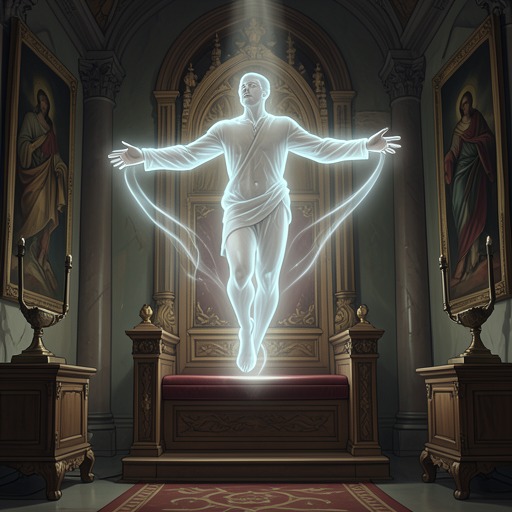
The Duchess’s Soul Separated from Her Body
The Blazing WorldThe Duchess’s Soul Separated from Her Body is the interval in which the Duchess of Newcastle leaves her body and accompanies the Empress of the Blazing-World through other worlds and conversations. Her disembodied state enables an unusually close intellectual and affectionate friendship with the Empress, but it does not erase the Duchess’s attachment to her husband or her return to mortal life. The episode also places that personal bond inside the book’s sustained debate over whether spirit can exist or act apart from matter.
Spiritual Travel and Material Nature
The Empress’s encounter with the Immaterial Spirits establishes both the possibility and the limits of spiritual communication. Seeking knowledge of her native world, she learns from the Fly-men that spirits appear in material vehicles, usually made of air, and can take on other substances. The spirits themselves say that they cannot move without their corporeal vehicles: pure spirits are immovable, while their vehicles are self-moving bodies. Their account makes embodiment not an incidental covering but the condition through which spiritual beings move and communicate.
That account sits beside the Empress’s own natural philosophy. She describes Nature as one infinite self-moving body, whose parts continually change through composition and division. The spirits likewise describe Nature as a living, self-knowing body comprising inanimate, sensitive, and rational matter, intermingled throughout; in this formulation, sensitive matter is life, rational matter is soul, and inanimate matter is body. They insist that natural lives, forms, and matter are inseparable, since a world belongs to material creatures rather than to immaterial ones. The Duchess’s later presence as a traveling soul thus unfolds within a text that repeatedly questions any simple division between life, motion, and body.
The spirits are also limited informants rather than all-knowing authorities. They explain that created spirits lack universal knowledge and that their foreknowledge depends on observing past and present events; they can even forget unrecorded things. When the Empress announces her wish to make a Jewish Cabbala, the spirits vanish, and she fears that her questions have caused them to be condemned to dark vehicles. Her distress leads her to seek them through the Fly-men and Worm-men. Against this background of uncertain supernatural knowledge, the Duchess’s counsel matters precisely because it treats spirits as fallible, not as possessors of divine secrets.
The Duchess as Companion and Counsel
When the Empress seeks a scribe for the Cabbala she hopes to compose, a spirit recommends the Duchess because her writing is founded on sense and reason. The Duchess arrives as a soul, and the Empress greets her with an embrace and a spiritual kiss. The Duchess warns that her handwriting resembles characters more than ordinary letters, but agrees that the Empress’s secretaries could learn to copy it. Their first exchange joins intimacy to practical work: the Empress wants the Duchess’s mind and writing, not merely her company.
The Duchess then challenges the project itself. Rather than trust the spirits to explain Jewish mysteries, she advises the Empress that created spirits, like mortals, lack absolute knowledge unless God grants it. A Cabbala, she argues, would not benefit the Empress or her people; a literal reading of Scripture is more instructive than private mystical interpretation, and ignorance of such mysteries should not condemn anyone. She similarly rejects philosophical, moral, and political Cabbalas as unnecessary elaborations: sense and reason can teach what nature permits people to know, morality rests on fearing God and loving one’s neighbour, and government rests on reward and punishment. Her intervention turns the Empress away from a grand interpretive scheme and toward limits, practical judgment, and reason.
The Duchess’s independent counsel also redirects the Empress’s desire for dominion. When the Empress asks whether the Duchess might become empress of another world, the Duchess is ready to risk her life for fame and achievement. The spirits answer that worlds are populous and conquest dangerous, then offer a different possibility: each person can create an immaterial world within the mind, populated and governed according to the creator’s choice. They contrast this inward world with the burdens of ruling material territory, which no monarch can fully enjoy or know. The Duchess’s spiritual companionship therefore becomes part of a larger account of world-making in which imaginative sovereignty offers an alternative to conquest.
Return, Marriage, and the Limits of Riches
During the voyage back, the Duchess asks why the Empress has not used her passage between worlds to enrich her native country or family, despite having wealth enough for the whole world. The Empress replies that abundant gold makes people more covetous and destructive, not more content: human greed exceeds any store of riches. The Duchess says she would accept wealth for the sake of her husband’s posterity, but not for herself, and identifies the elixir in the Golden Sands—not gold or jewels—as the thing she would most value, because it preserves life and health. Even that remains inaccessible: material things cannot travel between worlds as souls and spirits do, and no passage has been found for carrying the elixir away.
The Empress returns safely to the Blazing-World, where the Emperor greets her with a love equal to hers. Before the Duchess’s soul departs, the Emperor asks her to inspect the stables and riding houses he has built in the Empress’s absence, hoping to have horses like those associated with the Duke of Newcastle. Their splendor gives material form to the contrast between worlds: one double stable holds a hundred horses on each side, with gold, agate, carnelian, amber, pearl, crystal, and turquoise in its construction; the riding house has a floor of finely sifted Golden Sand and a frontage of carved emeralds. The Duchess can describe the Duke’s comparatively plain buildings, but cannot bring him the wealth or horses she sees.
The Emperor and Empress ask the Duchess to stay and arrange their theatre, but she longs to return to her dear husband. She leaves with civility after promising to visit again. Once back in her own body, she recounts her foreign experiences to the Duke when he is willing to hear them, including the Empress’s praise of him, the subjection of monarchs to the King of Esfi, and the magnificent horses and buildings. She tells him that, if a passage existed, he could have horses and building materials from the Blazing-World; the Duke answers that he has always found an obstruction to his good fortunes. Her return closes the spiritual visit without dissolving the worldly limits that shape the couple’s life.
Friendship, Art, and Narrative Significance
The separation from her body gives the Duchess access to the Empress’s world, but her loyalties remain divided in a meaningful rather than tragic way: she shares the Empress’s intellectual life and still desires reunion with her husband. Her spiritual mobility can cross boundaries that material objects cannot, yet it cannot transport the riches or life-preserving elixir that might alter the Duke’s circumstances. The episode thus sets imaginative and spiritual freedom against the stubborn restrictions of material existence.
The Duchess’s conversations also extend their friendship into literary criticism. She condemns methodical plays that, in her judgment, make a nursery of whining lovers rather than a school for wise and well-behaved men. The Emperor wants natural rather than artificial drama, and the Duchess offers to shape plays for the Blazing-World; she and the Empress also agree that its unusual inhabitants could make an effective farce. The Emperor and Empress ask her to remain until she has prepared this recreation, but she chooses to return to her husband. Her departure leaves the theatrical project unfinished for the time being, while her promise to come back keeps the friendship open. Through that choice, the narrative presents the Duchess not just as a visitor or secretary, but as a critic and creator whose judgment can influence the imagined world without severing her ties to her own.